
CHIMERA
2nd Place, MICCAI 2026 CHIMERA-Agent ChallengePolicy-orchestrated specialist agents for prostate-cancer decision support.
The gist
A prostate-cancer guideline is not one simple rule. It is a pathway. A patient moves through stages, and the same finding can mean different things depending on where they already stand. A PSA reading before a first biopsy carries different weight than the same reading during a routine follow-up years later. On top of that, real evidence is rarely tidy. It can be missing. It can point in two directions at once.
A single model that reads everything and hands back one decision has to hold all of that context in its head, invisibly. Nothing about the result is checkable from the outside. You cannot ask it which finding actually mattered, or why.
This project takes a different route. It builds a graph instead of a model. The graph is the guideline itself, the EAU prostate-cancer pathway, laid out as a series of narrow questions. Each question gets its own small specialist agent. That agent reads only the evidence relevant to its one question, then hands back a structured verdict. An orchestrator reads that verdict and decides which branch of the graph to follow next. The specialist never gets to make that call. Walk the process from the first question to the last, and two things come out together: a decision, and a full record of how the system got there. Which evidence it used. How confident it was at each step. A plain written explanation, checked against the evidence before anyone reads it.
the trick isn’t a bigger model. it’s a checkpoint you can double-check at every single step
Research question
Deciding whether a patient needs a biopsy is never a single lab value. A clinician reads imaging, blood biomarkers, and pathology together. She also has to know exactly where the patient stands in the pathway already, because the same PSA value means something different before a first biopsy than it does years later at a routine follow-up. Deciding what to do once cancer is already found works the same way. Context changes the meaning of the evidence.
Guidelines like the EAU pathway already encode this kind of reasoning. But they are written for a clinician to read and apply by hand. They are not written for a machine to run directly.
Real patient records make the problem harder still. Tests get skipped. Results arrive late, or never arrive at all. Two sources can disagree outright. An MRI reading can point one way while an earlier biopsy history points the other. An automated agent has to handle two problems at the same time, not just one. It has to actually follow the guideline's clinical logic, node by node, the way a specialist would. It also has to decide what to do when the evidence that logic depends on is missing, stale, or contradictory. Neither problem is optional. A model that ignores conflicts just to look decisive is dangerous. A model that refuses to decide the moment evidence looks messy is useless in practice. This project asks whether one system can handle both at once.
Solution
CHIMERA turns the EAU pathway into a graph a machine can actually run, instead of a document only a clinician can apply. Every node in that graph is one narrow clinical question. If the answer already sits in the record as a structured value, the system reads it directly. If the answer depends on narrative text, like a radiology report, that one question goes to a specialist agent.
Each specialist looks only at the evidence relevant to its own question. It never reads the whole case file. It responds with a structured verdict: its call, the findings behind that call, which variables it actually used, and a short local rationale. The specialist answers. The orchestrator decides which edge of the graph to follow next. That separation matters, because the specialist never gets to jump ahead in the pathway on its own. When evidence is missing, the graph does not simply stall. It has a built-in fallback for exactly that case: retrieve the missing piece, order the prerequisite test, or follow a dedicated branch for an incomplete history.
Walking one node of the policy graph, end to end
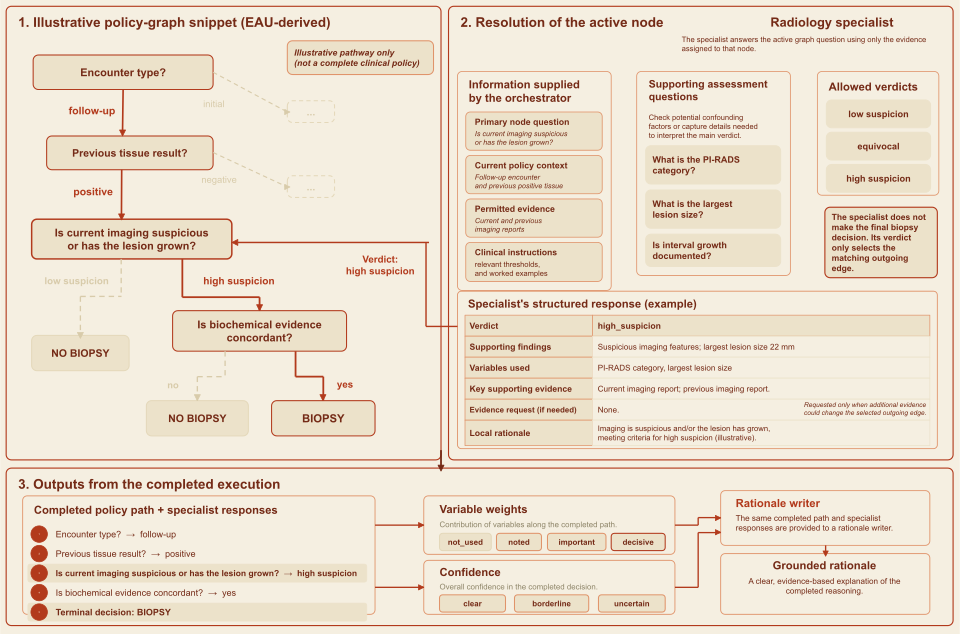
A single node resolved from graph to verdict to output: the specialist answers within its permitted evidence, the orchestrator follows the matching edge, and the completed path yields weights, a confidence level, and a grounded rationale.
This design earns clinical trust in three concrete ways.
- Every clinical variable gets a weight. Once a case finishes its walk through the graph, the trace shows exactly where each variable mattered, from not used to decisive. That weight comes from both the graph position and the specialist's own verdict on its key evidence versus its supporting evidence. Nothing goes in as a black-box input.
- Confidence tracks real disagreement. Each decision is labelled clear, borderline, or uncertain, built directly from the conflicts and gaps the system actually ran into along the way. Those labels get checked in a fixed order, so a weak downstream signal can never quietly override a stronger upstream one.
- The written rationale cannot rewrite the decision. A separate rationale writer turns the trace into a short explanation in plain language. It has no power to change the decision, the weights, or the confidence level. A validator then checks that explanation against the evidence actually revealed, before anyone sees it.
Results
The system was tested on all 163 labelled cases from the CHIMERA-Agent challenge. 91 of those cases were biopsy decisions. 72 were management decisions, meaning a cancer diagnosis already existed and the question was what to do next. Every case ran through the challenge's official, live evaluation interface.
0.8282
Overall evaluator score
163
Cases evaluated
78 / 91
Task 1 decisions correct
68 / 72
Task 2 decisions correct
Task 1, biopsy decision
Task 2, management decision
Management decisions score higher across the board. By that point in the pathway there is simply more accumulated evidence for the orchestrator to work with.
Both tasks got the decision right on the large majority of cases. That number alone would not tell the whole story, though. Every other score also stayed above 0.78 across both tasks. That includes how well the weights tracked what actually mattered, how well confidence tracked real ambiguity, and how well the written rationale matched the evidence. The graph is not adding interpretability as an afterthought bolted onto a black box. The decision and the audit trail come from the exact same trace.
What next
The real payoff of this design is that trust and performance come from the same source. Because every decision is a walk through an explicit graph, a clinician can open that trace and see exactly which evidence drove the outcome. She can see how confident the system was at every step. Nobody has to take a single opaque output on faith.
That kind of transparency matters most where a wrong call is costly and a silent one is worse. Biopsy and treatment-pathway decisions are the immediate case here. But the same pattern could carry over well beyond urology. Any clinical pathway written as a series of narrow questions could, in principle, become a graph like this one, with specialists at each node and an orchestrator that owns the routing.
The current limitation sits in depth, not architecture. The specialist agents hold task-focused knowledge rather than comprehensive clinical expertise. A question that falls just outside a specialist's intended scope gets answered less reliably than one squarely inside it. Sharpening that specialist knowledge is the next step. So is testing the whole pipeline against real clinician judgment, not only against the challenge's held-out labels. Both need to happen before this moves anywhere near actual clinical use.
Status & links
Awarded 2nd place in the CHIMERA-Agent Challenge at MICCAI 2026, to be presented at the MICCAI 2026 workshop. Code is available at github.com/ViciousDove19/chimera-baseline, explicitly marked as not for clinical use without external validation.